
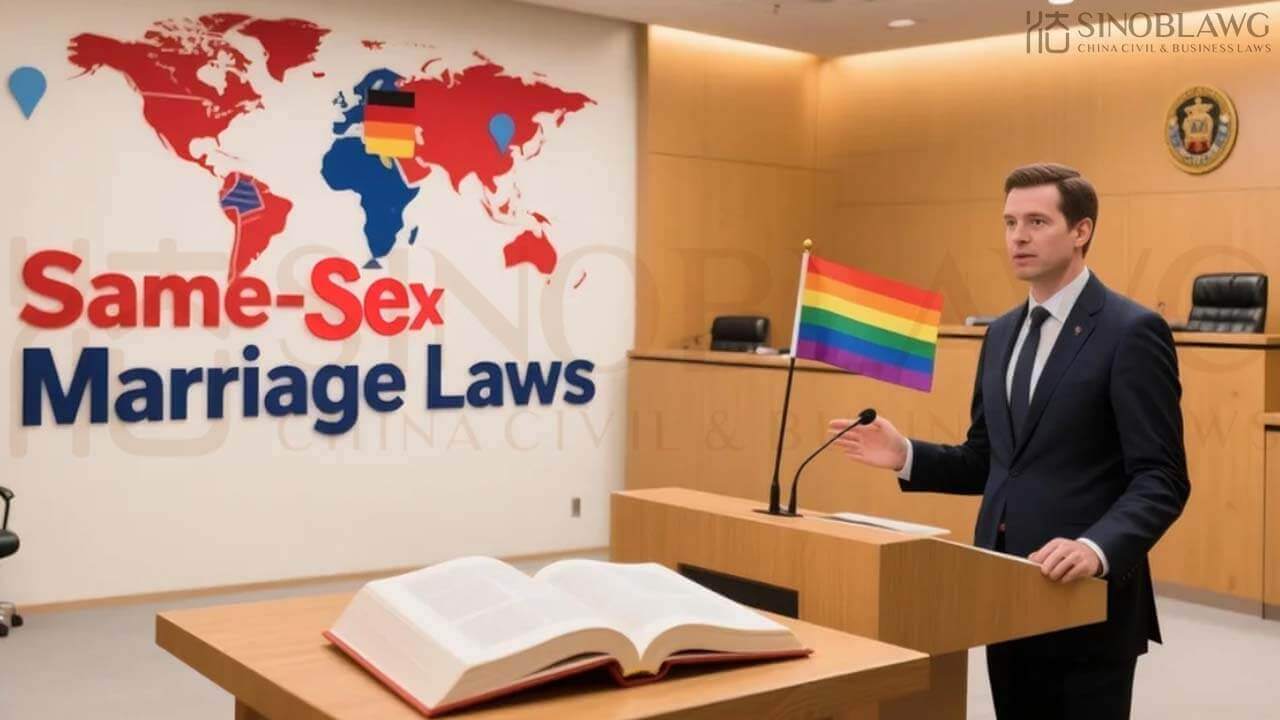

As LGBTQ social movements continue to develop globally, the rights of LGBTQ groups have gradually gained attention from governments, which contributes to the same-sex marriage as well. The LGBTQ community includes not only well-known groups such as lesbians and gays but also bisexuals, asexuals, transgenders, and others. In practice, the legalization of same-sex marriage has generally progressed through three stages: decriminalization, legal recognition, and registered partnership or same-sex marriage.[1] Some countries, such as Germany, have once introduced registered partnership system as an intermediate step, such, which allowed same-sex couples to formalize their relationships without granting full marital status. Unless otherwise specified, this article uses “same-sex marriage” in a broad sense, encompassing both registered partnerships and same-sex marriage.
This article focuses on the general legal frameworks for same-sex marriage in Germany and the United States to provide a brief view of global same-sex marriage laws.
Germany: The Life Partnership Act (Lebenspartnerschaftsgesetz – LPartG)
To protect same-sex couples from discrimination, Germany enacted the Life Partnership Act in 2001, marking the first legal recognition of same-sex relationships. In 2017, Germany passed “Marriage for All” (Ehe für alle), amending Section 1353(1) of the German Civil Code to state: “Marriage is entered into for life by two persons of different or the same sex.” (hereinafter referred as “2017 Amendment”) This granted same-sex couples full marital equality.
The Life Partnership Act detailed regulations on the formation and dissolution of partnerships, property rights, inheritance and other rights and obligations for same-sex couples.
Establishment and Dissolution of Partnerships: §1, §15
A same-sex partnership is established when two individuals declare their intent to form a life partnership before a registrar and requires:
I. Both parties must be of legal age;
II. Neither may be married or in an existing life partnership;
III. They must not be closely related (e.g. siblings or half-siblings).
The 2017 Amendment introduced a provision allowing life partnerships to convert into marriages.
Dissolution occurs upon death or court order. A court may terminate the partnership if:
I. The couple has lived apart for one year and both consent;
II. They have lived apart for three years (unilateral request);
III. Continuation would cause undue hardship (unzumutbare Härte).
Property Rights: §6, §7
The Life Partnership Act grants same-sex partners the same property regime as traditional heterosexual marriages. Under this system, same-sex couples automatically adopt the “community of accrued gains” (Zugewinngemeinschaft) unless they agree otherwise.
Inheritance Rights: §10
Same-sex partners are entitled to statutory inheritance rights from their deceased partner. The distribution is as follows:
I. If the deceased partner has first-degree relatives (parents, children, or siblings) who qualify as heirs, the surviving same-sex partner is entitled to one-quarter of the total estate;
II. If only second-degree relatives (grandparents, cousins, etc.) of the deceased qualify as heirs, the surviving partner is entitled to half of the estate;
III. If there are no first- or second-degree relatives, the surviving same-sex partner inherits the entire estate.
Parental Rights: §9
Following the 2017 Amendment to the German Civil Code, same-sex partners were granted full adoption rights identical to those of heterosexual married couples, including the right to jointly adopt children unrelated to either partner.
If one partner in a same-sex relationship holds sole custody of a minor child, the other partner retains the right to participate in decisions concerning the child. In emergency situations (Gefahr im Verzug), where immediate action is required to protect the child’s welfare, the non-custodial partner may take all lawful and necessary measures but must promptly inform the custodial parent afterward.
Family courts may restrict or revoke the decision-making authority of the non-custodial partner if doing so is “necessary for the child’s best interests” (zum Wohl des Kindes). Additionally, if the partners are in a state of “permanent separation” (nicht nur vorübergehend getrennt leben), the non-custodial partner loses the right to make decisions regarding the child.
United States: Obergefell v. Hodges, 576 U.S. 644 (2015)
The Obergefell v. Hodges symbolizes the legalization of same-sex marriage in the U.S., which originated from a series of lawsuits filed by 14 same-sex couples in Federal District Courts between January 2012 and February 2014. After the District Courts ruled in favor of the plaintiffs, the decisions were appealed to the Sixth Circuit. The Sixth Circuit consolidated these cases and subsequently overturned the lower courts’ rulings. This legal progression ultimately led to the Supreme Court’s review, resulting in the landmark Obergefell v. Hodges.
The case centered on whether the Fourteenth Amendment required state governments to recognize same-sex marriages. At its core, the justices’ debate focused on two pivotal issues:
First, whether same-sex marriage constituted a newly emerging right.
- The dissenting opinion argued that recognizing same-sex marriage as part of marital rights represented a redefinition of marriage’s traditional meaning and could undermine the institution of marriage itself. They contended that the Supreme Court’s decision to legalize same-sex marriage amounted to judicial overreach, disrupting democratic processes.
- The majority opinion, however, held that marriage is a fundamental right and that excluding same-sex couples violated both the Equal Protection Clause and Due Process Clause of the Fourteenth Amendment. Under U.S. constitutional law, any restriction on fundamental rights must be supported by compelling justification and evidence—yet the majority found that arguments against same-sex marriage failed to meet this standard.
Second, in the majority opinion, Justice Kennedy cited a series of precedents not only to establish marriage as a fundamental right, but also to pose a critical question: whether there exists legitimate justification to exclude any group from this institution.[2] Kennedy cautioned that if rights were solely defined by historical precedent, such temporal boundaries would become self-justifying—once a new group was excluded from a right, they might be perpetually barred from claiming it.[3]
Finally, regarding the tension between religious liberty and the fundamental rights of same-sex couples, the majority held that private moral convictions cannot override constitutional protections of basic rights. The dissenting view, however, maintained that religious freedom - being explicitly guaranteed by the Constitution - should take precedence over marital rights for same-sex couples.
The U.S. Supreme Court rendered a 5:4 final decision mandating that all states must license and recognize same-sex marriages under the same terms and conditions as opposite-sex marriages, pursuant to the Due Process Clause and Equal Protection Clause of the Fourteenth Amendment to the U.S. Constitution. The ruling further required states to recognize lawful same-sex marriages performed in other jurisdictions. With this landmark decision, same-sex marriage became legally recognized throughout the United States.
The progression and outcomes of same-sex marriage legalization in Germany and the United States offer a glimpse into the global trajectory of this movement. Some countries have transitioned from recognizing same-sex partnerships to acknowledging same-sex marriage, while others have amended their marriage laws to directly legalize same-sex unions. Regardless of the path taken, the legalization of same-sex marriage represents an inevitable trend in social development.
[1] Cao Weifeng. (2013). The Evolution of Same-Sex Marriage Legislation and Related Rights in Nordic Countries—Focusing on Sweden. Social Sciences Review (New Theory Edition), 28(01), pp102-105.
[2] Obergefell v. Hodges, 576 U.S. 644 (2015) Opinion of the Court, at 18.
[3] Loving v. Virginia, 388 U.S. 1 (1967), at 12; Lawrence, 539 U.S., at 566-567.




Comments