


Early this month of October, I attended the Cambridge Forum for international family lawyers in Lousanne Switzerland. As always, it is a great event for peer family lawyers across the globe to be engaged in cross-border family law practices to meet, discuss, learn and enjoy.

all participants of Cambridge Forum for international family lawyers
This year, the Forum addressed several topics that are often encountered by international family lawyers around the globe, represented by 40+ lawyers from 30+ jurisdictions on the Cambridge Forum in Lousanne, among which the topic about post-divorce spousal support or alimony struck me most.
Here is why.
I. Canadian Model for Protecting Divorced Women
It is about spousal support after divorce or alimony as termed in some jurisdictions, and how much this support can be paid and how long it will last after divorce.
The practice in Canada, to be specific, Ontario province, aroused surprise and amusement among the forum participants. Karon, a veteran family lawyer from Toronto introduced a case in which the wife was awarded a monthly payment of alimony by her former husband, in addition to whatever equalization of matrimonal properties had vested in her pocket already, and some years later, when she became aware of her formal husband had been making a lot more money than at the time of their divorce, she applied to court asking for upward adjustment of the monthly alimony, much a shock to the audience in the forum, this lady succeeded in getting more monthly alimony from her former husband after many years of divorce.
Wow...
The fun part of the story is not coming to its climax yet. When asked about when in your jurisdiction payment of alimony shall terminate, most jurisdictions will terminate the payment of alimony upon the former wife remarrying. And yet, in Canada, it won't stop there. In other words, despite getting married again which means better financial conditions (at least in most cases), Canadian divorced ladies can continue to enjoy the benefit of alimony paid by former husband.
Everybody else was shocked, amused and puzzled! That is the legal practice in Canada.
I double checked on this practice by searching online materials. On the webiste of Departmetn of Justice of Canada, I found the following information:
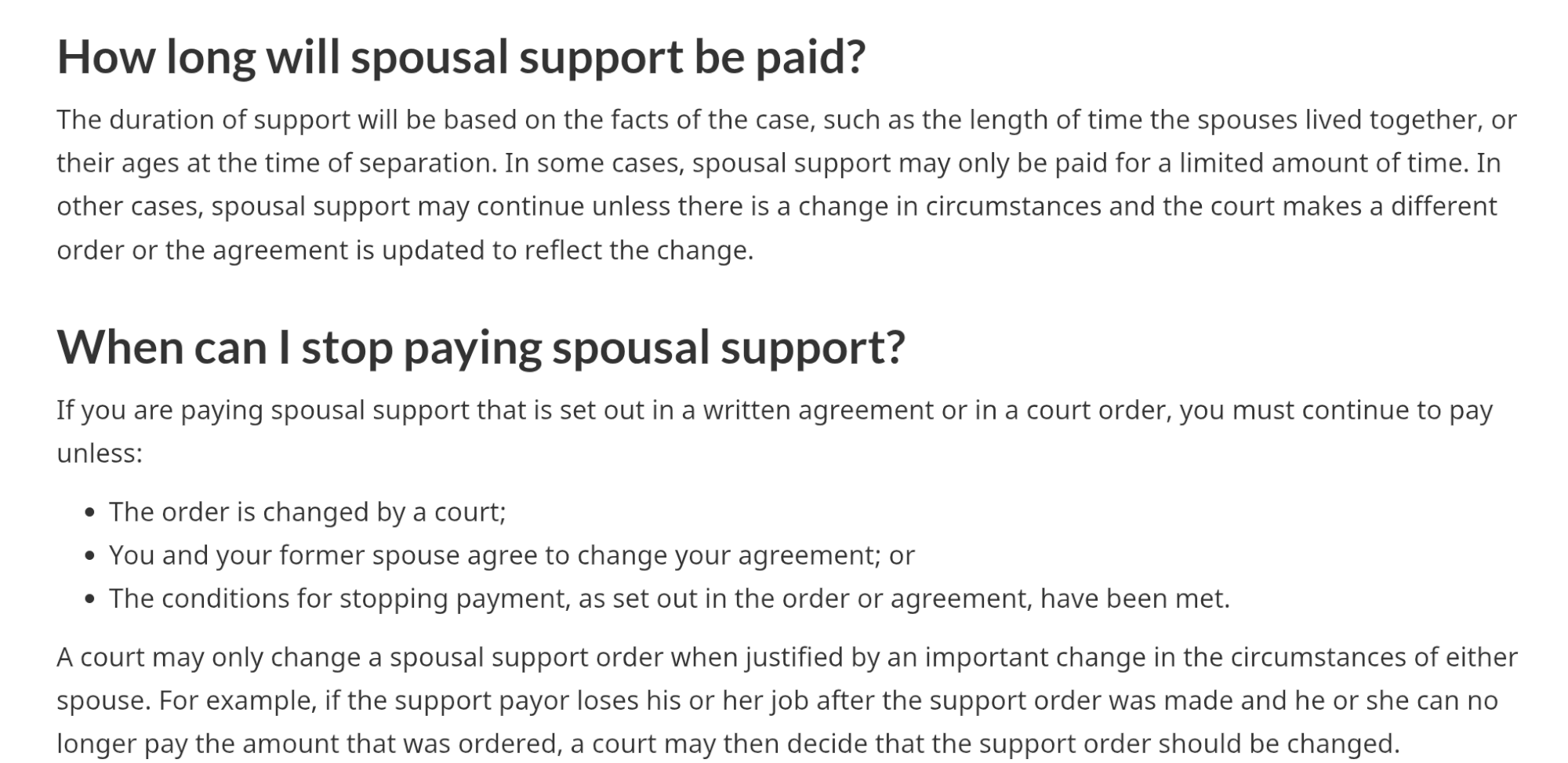
It is true that remarrying is not a statutory ground for stopping alimony.
At the end of discussion, it is a universal consensus that Canada is the paradise for divorcing ladies.
II. Landscape on Protecting Divorced Women in China
I feel ashamed to touch on this issue. Really!
What protection Chinese women could have in the event of divorce in terms of financial distribution and support?
(1) Financial Protection for Wives
It may not be too much to say there is nothing significant in China divorce laws when it comes to protecting women's right in terms of matrimonial property splitting and financial support.
First of all, we don't have any law mandating post-divorce alimony payment at all!
As you may know, the default matrimonial property regime in Chinese marriage law is "community property" whereby assets and properties acquired by one spouse in the course of their marriage are considered as "community property" jointly owned by the couple dispite that the title of such assets may be registered in one spouse's name; on the other hand, any assets or properties prior to the marriage shall remain owned by that spouse unless that asset is mixed and blended with other community properties, unable to be discerned. A special feature of Chinese matrimonial property regime is that inheritance by one spouse during their marriage is considered part of the community property, but this won't be necessarily in favor of wives.
Under the default marital property regime, in case of divorce, Chinese courts will divide the community properties taking into account various factors such as length of marriage, child support, fault of the parties and domestic violence. In other words, Chinese courts won't touch those properties and assets owned by the either party prior to marriage.
Oh, Chinese law even provides clearly in its Civil Code (inherited from previous marriage and family laws) that upon divorce, Chinese courts shall give regards to the interests of the female party, but in practice this doesn't mean much to wives caught in divorce battles.
Well, housewives in China may claim compensation for contributing most in domestic arena, something that aroused much sensentional attention when it came into law, but in practice, this seldom translates into a big meaningful financial award to wives.
(2) Procedural Deficiencies in the System
In practice, there are some obvious procedural deficiencies in protecting women's rights and interests upon divorce in China.
(i) Unlike most jurisdictions, China doesn't even have mandatory disclosure of assets controlled by each spouse, which is only possible when ordered by judges.
(ii) China courts are generally shy to deal with assets outside of China. In most cases, Chinese courts shun the issue of dealings with assets and properties outside Chinese mainland, being aware of the fact that Chinese court judgments cannot be enforced in most jurisdictions except for a dozen that have bilateral treaties. Personally I don't agree with such stance and it is my belief that Chinese family lawyers should push our courts to be braver in dealing with overseas assets.
At the end, just want to say, for Chinese women caught in cross border divorce battle, the choice of forum or jurisdiction to file their divorce is a critical and strategical issue to consider and plan carefully.




Comments